
How do you live in a world that is becoming increasingly difficult to understand and accept? Emma Ruth Rundle doesn’t pretend to know the answer. On These Killing Times, anger, fear and helplessness take the form of powerful, guitar-driven songs that evoke the sound of the 1990s. It is a much louder record than the intimate Engine of Hell, but not necessarily a less vulnerable one. When we spoke five years ago, around the release of her previous album, Rundle talked primarily about trying to reclaim herself. Her music was almost unbearably intimate then — quiet, fragile, demanding attention and closeness from the listener.
Today, the American artist still doesn’t shy away from difficult emotions, but she is increasingly looking beyond her own experience. On These Killing Times, personal suffering gives way to anger at the world, and solitude to a need for community. In our latest conversation, questions about the new album quickly turn out to be only a starting point. We talk about the fear of climate catastrophe, violence, religion, responsibility for others and why it is so hard to believe that the future might still hold something good. We also talk about neighbors, sharing food and befriending crows. Perhaps the answer to that opening question lies in these seemingly small gestures.
Content warning: This interview contains references to suicidal thoughts.
[MOŻESZ PRZECZYTAĆ TEN WYWIAD PO POLSKU]
I feel like These Killing Times opens up a different kind of conversation — as though your focus has shifted. There’s more of the outside world in it than on Engine of Hell, where you were confronting your own demons. Does that mean you’ve left those experiences behind?
I don’t think I’ve left those experiences behind. They’re still part of me. But I think the state of the world demands our attention in a different way now. And I’m getting older. There’s a point where it becomes less about yourself and more about what’s happening around you. I still want the work to be authentic and connected to my personal experience, but the emotional energy this time is angrier and more focused on this particular moment. We’re living through the Anthropocene. My attention has shifted outward, even though all of those personal feelings are still there.
I really like how, when you talk about the new album, you keep coming back to the sense of community and the importance of being surrounded by friends. I find that interesting because, as a society, we seem to be growing further and further apart, and loneliness is becoming a serious issue. To me, choosing to come together and create something with other people almost feels like a radical act in itself. Do you see it that way too?
I don’t know if I would call it radical, but I think it’s necessary. Sitting alone and doomscrolling fosters this feeling of despair, powerlessness and hopelessness. If we’re going to keep living, what are we living for? It can be hard to come out of isolation. I’m introverted and I’m afraid of people sometimes. But I feel sane when I’m around my friends and we’re doing something together. I can’t solve climate change by myself, but I can know my neighbors. I can share food with them. Maybe that is radical in some way, because power benefits from divide and conquer. We’re all sitting alone with this little panopticon in our hands. The phone is a necessary evil, but I don’t want to tour alone anymore. I want collaboration, camaraderie and togetherness.
The last time we saw each other, you were touring completely on your own.
Those solo tours were really informative for me. Music is basically my whole life, so after being out there alone for so long, I started missing having a crew and being around bands. There’s this idea of the empowered person who does everything themselves, and I went as far into isolation as I possibly could. I was also going through intense heartbreak. It made me rethink the idea that one romantic person should fulfill all your needs, but also the idea that you should be completely self-sufficient. We’re social creatures. I read this book called A General Theory of Love, written by neuroscientists, and it talks about these resonant states between people — the idea that being together actually changes us. Concerts do that too. This idea of rugged individualism in America is fucked up. It’s false. I feel much better as part of a troop: working together, laughing, eating together, helping each other.
I’ve also read that prolonged loneliness activates the same areas of the brain involved in physical pain. That’s really sad and disturbing.
Solitary confinement is used as punishment and torture. And yet we’re living in a system that increasingly resembles that kind of isolation. Maybe it’s by design? I should probably put on my tinfoil hat now [laughs]. But the opposite of that is people getting together, talking, organizing, playing in bands, and having a shared goal.
I’d like to revisit our last interview and look at the new album through the lens of Engine of Hell. Back then, we talked about your falsetto, and you explained that it was such a quiet, fragile voice that the listener had to come closer to hear it. Now you’ve made a much louder, more powerful record. Do you feel like you’re expressing a different kind of vulnerability this time?
Engine of Hell was so fragile and quiet and close, and that was part of what made it intense. These Killing Times is intense in a different way. I’m using my full voice, my mixed voice. There are moments where I’m thinking about Judas Priest, or trying to find this witchy voice. It doesn’t necessarily have to be beautiful. It can just be cool and fun and freeing. There’s a kind of crone energy to it — conjuring different voices. The subject matter warrants a full voice. There are still fragile, quieter moments, but on the more anthemic rock songs I wanted to use these other voices.
My partner was listening to These Killing Times with me, and he said every track sounds like a single straight out of rock radio.
Rock radio is what I think of, too! When my friends ask me what kind of music my new record is, I’m like, “Well, it’s kind of like listening to rock radio in the ’90s.”
Around the release of Engine of Hell, you were going through a period of enormous change. I remember you talking about trying to reconnect with yourself and figure out who you were. Five years later, is there anything about the person you were during those difficult years that you still value and wouldn’t want to lose?
I wouldn’t want to lose any of it. It was necessary and important and hard and vulnerable. Sobriety was a big part of that. And sobriety isn’t just abstinence — it’s accountability for your actions and the harm you’ve caused. I’m not perfect at it, but there’s something freeing and empowering about being able to apologize and look honestly at your own behavior. It helped me move out of a victim mentality and into a more empowered place. I wouldn’t want to relive that period, but I’m glad I went through it.
Has your understanding of what it means to take care of yourself changed during this time?
Yes. I think there are a lot of things we instinctively learn to do to protect ourselves. Isolation is a big one for me. When I go into a bad mental-health period or I’m struggling, my instinct is to get as far away from other people as possible. If you’re suffering from acute grief or a loss, that’s understandable. But I’ve done it enough times to know that ultimately it doesn’t work. Sometimes opposite action is what’s needed. Figuring out when you genuinely need rest and when that rest has become maladaptive and is actually contributing to a mental-health decline is really tricky. As you get older, it’s like learning an instrument — you learn your patterns. Sometimes self-care for me means forcing myself to go be around people, or doing something for somebody else, or learning to honestly tell someone how I feel. Those things are hard and can feel unnatural, but ultimately they’re better for me.
Have you discovered anything about yourself that surprised you?
Yeah. Especially over the last year or two of making this record, I spent months looking outside myself for someone else to take charge. I felt like I needed the validation and support of an outside force in order to continue being an artist. I needed a label to sign me, or someone with a strong personality to come and steer the ship. And that just didn’t work out. I couldn’t get signed after the last label. I had lots of meetings and there was interest, but people wanted demos, which is very common now. It forced me into a position where I had to decide: I can just do this. I have to do this on my own. What is it about me that makes me feel I’m not worthy or capable enough to do the thing I’ve already been doing for twenty years? I love record labels, and some of them are really cool. I’m not saying we need to get rid of them.
But I had to overcome this little scared child who says, “I’m not good enough. I’m not smart enough. I’m not capable. I’m not strong enough to put myself out into the world without somebody there protecting me.” And then I thought: what is that about? It’s just music. I’m not going to war. It’s just an album. It’s not rocket science. Making art is the thing I know how to do. Taking charge of myself, my career and the trajectory of what I want to do made me assess my values. If I’m going to do this, how do I want to do it? I want to do it with people who are aligned with my ideas — even politically. Finding the right collaborators on the business side and seeing that I was capable made me realize that we actually do have some agency as individuals. Fear is the thing that stops us. It’s really transformed me as a person. I’m much more comfortable saying what I want or don’t want and having honest conversations with people. When I was younger, I had a lot of people-pleasing behavior. Now I realize we can just say honest things to each other, and that’s actually very respectful.
I completely understand. I struggle with something similar myself. Sometimes I find it much easier to speak my mind, but at other times I almost feel like I should apologize just for existing.
I think some of that comes from being conditioned in a female body from such a young age. We’re taught that that’s what we’re supposed to do. And overcoming that doesn’t mean we have to go around saying, “Fuck you” to everybody. It’s just about being cool and being good, but not being walked on.
You’ve mentioned your neighbors a few times now. Getting to know them seems to have been quite a formative experience for you.
I live way out in East Portland now, in what would be considered a suburb, and it’s very culturally diverse. There are people from all over the world living around here. The turning point was really my next-door neighbors. They’re from Ukraine, and they don’t speak a lot of English, but when I first moved in they just started coming over and helping me do things. They saw me struggling through the fence while I was putting up a wooden fence and pouring concrete in the winter. My neighbor saw this and just came over and started helping. I was like, “This is so weird. What is happening?” And then I thought: how cool is that? Slowly I started talking to the neighbors, saying hello and introducing myself. I’ve lived here for four years now. I have my neighbors’ numbers. They give me food from their garden when they have too many raspberries or something. At first I was like, “What am I supposed to do?” And then I realized it doesn’t have to be a big thing. It’s totally chill. I can do that too. I don’t have to have a huge conversation or know everything about them. I have a very productive plum tree, so my friend John and I have walked around passing out bags of plums to the neighbors and leaving them at their doors.
Let’s get back to These Killing Times. You mentioned Siamese Dream by The Smashing Pumpkins as an important reference point, especially the way it turns anxiety and tension into something energetic. Was there a moment during recording when you felt the sheer joy of playing loud music?
Absolutely, yes. Especially when my friend Nick Reinhart came over and played this guitar solo on “Human Kindness.” Jess and Troy and I had already recorded all the basic tracks, and I’d done all my guitar overdubs, but it felt like that was the thing that was missing. Then he played this incredible guitar solo, and we were all just… I was standing up going, “Ahhh!” It was so fun.
“Powerless” previously had a very different title: “Noam Chomsky Is Dead to Me,” which is a pretty great title. Can you tell me a little more about where that came from?
Yeah. I wrote that song after… I haven’t really talked that much about the Epstein stuff in interviews for this record. I idolized Noam Chomsky growing up. I really thought he was this brilliant person seeking to deconstruct power by examining the media and the press and all this stuff. And then to see him not only hanging out with Epstein, but praising Woody Allen… I was crestfallen. Just so, so, so sad. To me, it represented this insane level of corruption. I felt so disappointed, in a way that’s connected to a deep sadness and disappointment from other parts of life, I guess. That was the last song I wrote for the record. It was an idea that came out really quickly, and I wasn’t even going to put it on the record. But I sent it to my friend John, and he was like, “Dear, you must record this.” I was like, “Okay.” Being the last song I wrote, and seeing that particular story, I think it made me fully realize how just… fucked people in power are. Power is ultimately corrupting. Money is corrupting. The class struggle is the real struggle. I was also thinking a lot about the story of John Henry, which is a folk tale here. It kind of brought all the themes of the record together into this one song.
Actually, I’m reading a book about exactly that — Monsters: What Do We Do with Great Art by Bad People? by Claire Dederer. The author tries to find an answer to that question. It isn’t easy.
I’m reading this book called We Will Not Cancel Us and Other Dreams of Transformative Justice. I’m not done with it yet, but it talks more about abolitionist and activist movements and how we deal with harm. I’ll give you an example: Cesar Chavez was a labor organizer in the United States who did a lot of work for migrant workers. But it’s come out that he was a doer of harm. In almost every city there’s a street with his name, and his name has just been taken down here in Portland. This book asks: how do we handle this without bringing in punitive, prison-type punishments for those who do harm? What would be the next way to repair this stuff? I’m not done with the book, and I don’t want to speak for the author, but it’s making me think about what happens if we eject every person who does harm. That leads to a scary place too. And I want to be clear: I do not want rapists in the scene. I don’t want predators at my shows. I would never want to put someone in my band or onstage, in a position of power, if there were even an inkling that they could potentially have access to vulnerable people. But philosophically, I’m interested in opening a dialogue around whether rehabilitation is possible.
I think it’s a fascinating and incredibly complicated subject. Everyone has different boundaries and can perceive the same situation differently, and I think people have a right to that. At the same time, I’m wary of these internet courts that can condemn someone very quickly. Life is nuanced. Not everything you read necessarily turns out to be true, and sometimes you’re only hearing one person’s perspective. That’s what scares me too — that this can ruin people’s lives. So what do we do then?
The internet is a very volatile place. The book talks about how unsettling it is that someone can be cancelled because a certain in-group doesn’t like them, someone else can have done something harmful, and another person can have committed an egregious harm — and the result of all those different cancellations can be the same. It leaves very little room for corrected behavior. I think the baseline is that we’re lacking some fundamental belief that all human beings deserve equal rights, autonomy and respect. That needs to be a deeply held belief. Forcing your will on other people is at the core of what is evil, I believe — especially for your own enrichment. I’m saying these things because I’m always trying to investigate and overcome my base violent instinct — which is to behead people. Especially men. I want to seek vengeance through violent means against the men who harm vulnerable people. But that’s why I feel like I have a mission to investigate what the most effective way is to preserve the integrity of all human beings. I’m not a philosopher — I’m just a lady who plays guitar. But I think about this stuff a lot. Because if I just let that inner animal run wild, I’d be strapped with a machine gun, running down to wherever they congregate and saying goodbye to everybody.
You’ve described “God’s Picture” as one of the central songs on the album, and religious imagery plays an important role in it. You’re not religious, are you?
No.
Neither am I, but I’m fascinated by religious imagery. I love churches, paintings — that whole visual world. Do you ever wonder why people who aren’t religious can still feel so drawn to it?
I think specifically the Christian stuff is so… it’s the backdrop of our Western civilization and our society, and a lot of our ideas and social rules are based on it. It’s mythology. We as humans love stories, and we need stories to contextualize our own experiences. It’s just a function of humanity, right? Christianity provides that on a huge scale, and it touches all of us in the Western world simply because it does. It’s just a fact. And it’s particularly potent in this moment, with the rise of Christian nationalism here. I also find that sense of awe and divine wonder in spaces like churches. They’re designed for it. You know, reverb is a church and a pedal. A space, something bigger than yourself — the grandiosity and beauty of it does something to us. In the same way, looking at this ancient oak tree in my backyard makes me feel very small and part of something greater. From what I can understand, that’s also just part of the human experience.
Christianity is the most accessible thing around to give us a framework for those thoughts and experiences. But in the song “God’s Picture,” it’s a little satirical when I say, “God’s got a picture of the whole world burning.” I’m thinking about the divine right of kings to rule — this idea that those in power, making decisions, have a deeply held belief that they are divinely directed by God. And it’s an insanity and a delusion. Why would you march forward with all of this shit that we’ve seen? LA was on fire from all directions. So many of my friends were evacuating. Houses of people I know burned down. It was catastrophic. And not just here — this is happening across the world. So how could you be in a position of power and still be moving towards all these legislative things that empower the burning of fossil fuels, which we know is leading to climate collapse? One explanation is that these people think, “This is God’s will. It is God’s will that we burn the whole Earth.” There’s this vision of judgment, of Judgment Day — this bananas idea that they are manufacturing some kind of apocalyptic scenario to the benefit of their religious beliefs. But mostly it boils down to this idea that the people in charge, backed by Christian nationalism, might have some idea that this is God’s picture.
Speaking of “God’s Picture,” we have to talk about the visual world of the album. I’ve watched the video over and over again — it’s beautiful and so clever. How did that visual concept come together, and who did you collaborate with on it?
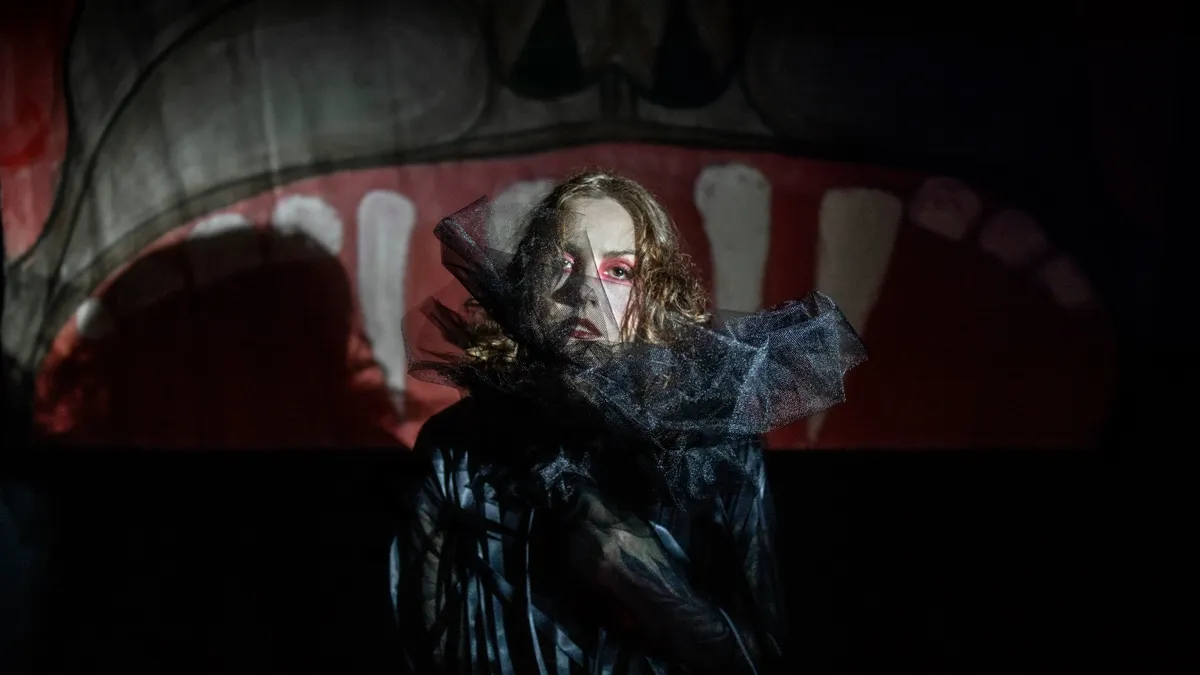
That was the first visual thing I made for this record, and I had a lot of ideas inspired by the lyrics. I wanted to place the characters in a different time — this sort of mixture of a historical, European-type period. I had a lot of fun building all the sets. It was a nice way for me to step outside of thinking about these heavy subjects and sitting there with the guitar for hours a day by myself, which can be maddening. Getting to make those mountains out of trash and paper, painting the backdrops and the sets, planning all the costumes and thinking about the characters — that was really fun. The main character who opens the video is loosely based on this Elizabethan figure who’s very ominous and sort of reveling in this lavish greed, with all the overindulgence and the black teeth, smiling as she’s singing these words.
I love films and practical effects — things from the ’80s, Jim Henson stuff. I love fantasy and fairy tales, and I think those are also very accessible formats for satire and for talking about things that are happening now without being super specific and on the nose. For me, it was also an opportunity to have some fun and to play with gender. I don’t have anyone telling me I can’t do that anymore, and I think it’s important and fun to do. My main collaborator on the visuals for this album — the photos and everything — is my best friend Mason Rose, who mostly photographs queer experience here. And I wanted to bring all my friends into it, all my artist friends. Blake Armstrong, who I’ve had a really long friendship with, is a makeup artist and a painter. He came and worked on it and was the goblin in that video. It was really fun to do.
You’ve said you want this record to make people feel that there’s still hope, that there’s still something we can do. But do you really believe that? Because I personally struggle with believing that things can still get better.
When you say that, which issue do you think is the most daunting?
Climate change. Literally the end of the world.
Especially since the UN announcement a couple of weeks ago.
Yeah. It feels like there’s nothing you can do about it. And it’s terrifying.
I agree that we need the people in power to change the laws, and that we as individuals don’t have a lot of power. But there are things we can do on a small scale. There’s an endless list of things we can do as individuals just as a baseline of responsibility, without even giving up that much convenience. We don’t need a new thing every time, every season. God, it’s really mind-blowing to me. If I could ask people to do one thing: please cancel your Amazon. That’s the first, easiest thing to do. Whatever movies or shows you want, you can get them elsewhere. I’ve found that the library has amazing films. The library has a streaming service. It’s free. But do I believe there’s still hope? On some level, yes. On some level, no.
Every day it’s different. The climate thing, I agree, is the most devastating thing to think about, because it’s getting to the point where it’s undeniable. The heat this summer, the footage from Nepal, the fires… It was really interesting seeing the UK go totally brown and have all those fires this year. It has arrived, y’all. It’s happening. And it’s not my area of expertise, but what I do think is: what is the alternative? If we give in to this and accept that this is the reality that awaits everyone on Earth, why are we even working or doing anything? What should we do? I think that’s part of what the record asks, and the reason why I closed it with the question: what should we live for beyond the valley of fear? What are the things we think are of value beyond our immediate experience of pleasure?
I don’t have any children, but my friend just had a baby. I didn’t really know anything about babies, but I went over there and I’ve been holding the baby and singing to the baby. It fills me with this profound feeling of responsibility towards this innocent life. It also made me realize how backwards the whole world is. If our laws were focused on the well-being of people in the future, we’d be living in a very different world. I don’t know what we’re going to do. But I think that’s why it’s good to connect with other people and remember that we all have different specialties as humans.
We work in the music world. I think focusing on connecting people who are into music and go to shows, and maintaining some of that connectedness through a kind of anarchist punk ethos — keeping capitalism outside of it as much as possible, so that people aren’t just going to buy a product of an experience at a show. A show is an opportunity to see the people you always see at shows, make friends with them, hang out with them. Maybe something comes from that. It’s about rethinking how we live on an individual basis and then moving that into groups. Because what is the alternative? I struggle with suicidality and wanting to just jump off a bridge sometimes. I don’t do that, mostly because I know it would ruin my sister’s life. And some days, that’s enough of a reason. If we’re going to keep going, we need to have a reason and a way to do it, because pleasure is not enough. For me, I guess. Money isn’t it either. I really don’t know what it would take. What do you think we should do?
Oh my God, I don’t know. This is probably kind of selfish, but I just hope I won’t be around anymore when the world really starts falling apart. I don’t want to see people fighting over water. That’s what scares me. Choosing not to have children was a conscious decision for me, and the state of the world is a big part of why I don’t want them. And it’s not just the environment. What’s happening on the internet scares me, what’s happening with AI, all the fake stuff, the rise of right-wing movements… If I had a baby, I think I’d go crazy trying to protect it.
Yeah. Absolutely. Same.
So unfortunately, I don’t have an answer. I just hope we’ll still have some good things in life. We’re not that young anymore, so…
I know. I think about that too — that we’ll be dead. But there are going to be plenty of people who aren’t. That’s our problem. That’s the whole mind shift we need to come to as a society. Like, that lady who’s struggling down the street carrying her groceries because she’s 75 and by herself. At some point, I might have seen that and thought, everyone’s doing their own thing. But now I’m like, no — that is my problem. That lady is my problem right now, in this moment. I don’t know. Just be kind. Be excellent to each other in the meantime. Try to do something kind. I don’t know. I’m scared.
I know what you mean. Maybe we should end on a slightly more uplifting note. What’s something in your life right now that you find genuinely beautiful?
Okay. I’ll tell you about these crows in my backyard. They come every day and sit in that big oak tree. When I first moved into this house, they used to dive-bomb me a little bit, like they were attacking me. And then one day I realized I could make friends with them. I started feeding them by putting food out while I was there. I would sing to them and talk to them. I put water out for them too. I’ve been doing this every day when I’m home for about three years now. I never ask them to come to me or try to get them to sit on me or anything. But now, if I go into the backyard and call them, they come to the tree. Sometimes the crows and I sit out there for hours and just hang out together. I have this deep feeling that this is a cool, small example of what a human being can do. We have all these insane gifts in our thinking and our skills, and we can use them to steward the creatures around us without trying to get anything from them except their company and their happiness. It’s really beautiful and I love it.
One comment