
Protomartyr make a triumphant return with their seventh studio album, Hotel Usona [out September 25]. When a band has been around for 16 years and released so many records, it’s hard to surprise listeners with something new or fresh. Yet this Detroit band proves that it’s still possible. There are previously unexplored influences from Middle Eastern music, and sonically, this is their most powerful work to date – and, in my opinion, one of their best albums. The sheer richness of the arrangements is almost overwhelming. Producer Dave Fridmann certainly deserves a lot of credit for that [he’s produced 12 albums by The Flaming Lips, including Yoshimi Battles the Pink Robots, as well as Oracular Spectacular by MGMT, Some Loud Thunder by Clap Your Hands Say Yeah, Marauder by Interpol, and Drums and Guns by Low].
[MOŻESZ PRZECZYTAĆ TEN WYWIAD PO POLSKU]
It’s becoming increasingly rare to see bands from the independent scene successfully embrace the concept album format. The narrative of Hotel Usona revolves around the lives and dilemmas of the inhabitants of the titular hotel. Joe writes about Trump, ICE, JD Vance, AI, distorted patriotism, violence, and the weight of being a father. The band’s official website has been transformed into the website of a fictional hotel. You can browse the rooms on offer and read the entries in its guestbook, which I highly recommend – they reveal an even more intriguing picture of the place.
The band’s vocalist, Joe Casey, talked to me about the making of Hotel Usona, becoming a father, and drawing inspiration from children’s books. He also lamented the price of photocopiers and the omnipresence of AI. He’s a fantastic person to talk to and a really smart guy. I hope you enjoy reading this interview at least half as much as I enjoyed having the conversation.
Yeah, great times!
You released Ultimate Success Today during the pandemic. Do you regret putting that album out then?
No, I don’t. It’s confusing to think back on it. Every record is like that. You never know if it’s going to be the last one you put out. You don’t know what the world is going to throw at you, and bands break up all the time. So it was kind of like, “Let’s do it.” When we were putting the record out, we thought, “Maybe this is going to last a week. What’s COVID? Is this going to be like bird flu or mad cow disease or something like that, where it’s just a punchline in two years?” But then, when it really started sticking around, we thought, “Well, this is bad. Our whole livelihood is gone, and we’ll never tour again.” I remember a lot of the reviews were saying, “Why did Protomartyr put out a record about death and dying and disease right now?” I guess I’m just a psychic. I don’t know.
I would think it was a good listen for some people during that time. I’ve heard some people say they can never listen to that record again because it reminds them of that time. And then a lot of other people said, “Hey, I just listened to stuff that made me feel happy.” I’m glad we put it out. It definitely has some of our best songs on it, I think, but it also certainly represents its time.
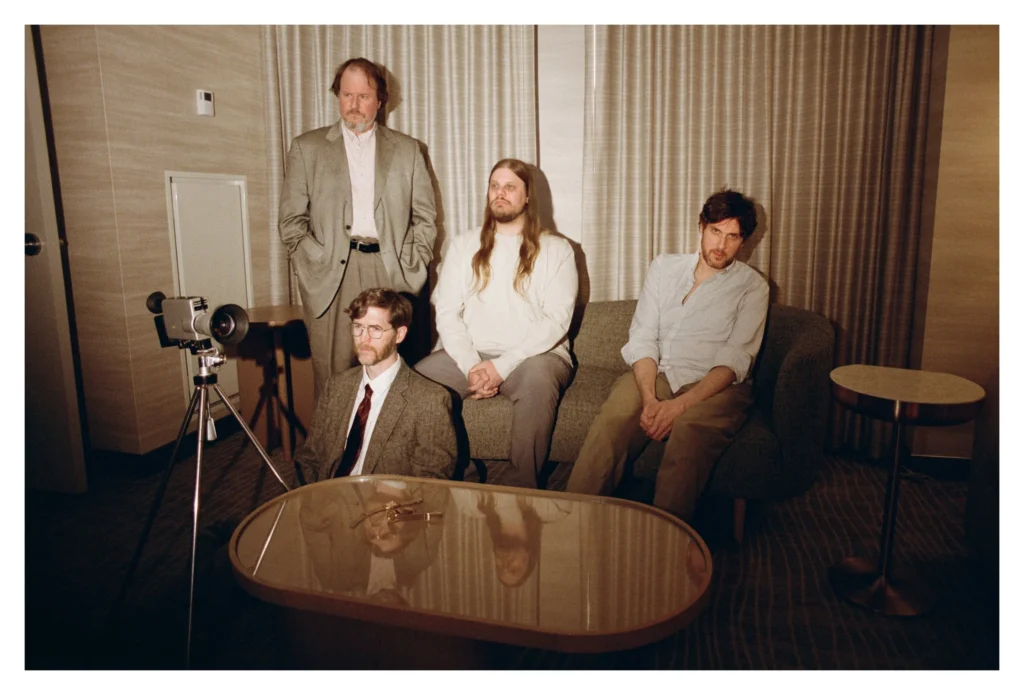
Obviously, we’re here to talk about your new album, Hotel Usona. I’ve been listening to it over and over again, and I think it’s amazing. I’ve also seen some reviews, and they’ve all been very positive. Does that make you feel any less nervous about the upcoming release, knowing that it’s already being so well received? Or is there still some insecurity?
Yeah, there’s always insecurity, and that’s just on the rest of the band and me. I’m one of those people who will read the reviews, and there’ll be twenty good reviews and one that’s like, “Eh, it’s not so good.” And I’ll think, “That’s the one. Why?” So I have to mentally prepare myself for that. The problem with records nowadays is that we recorded this one about a year ago, so just to finally have it come out is great. There’s all this anticipation. You want it to get out, and once it’s out, I’ll be happy to think about anything else.
But you still have to talk about it!
Yeah, but that’s fine. I don’t mind talking about it. You might put out a stinker. People might say, “This is bad.” And you really won’t know what its legacy is going to be until much later. I thought our last record was really good. I thought, “Oh, we’re writing short, punchy songs. They’re not slow.” I thought people would really like that. But in retrospect, it seems like people didn’t like that as much as they liked our slow, long songs. So I can’t tell. I don’t know what people like.
Nobody knows, I guess.
No.
At what point did these songs start to feel like different rooms in this hotel? Was it a concept you wrote into, or something you discovered once the songs were already there?
We always do this: Greg and the band go off and write the music, and then I hear it and write the words to it. This time, Alex, the drummer, and I both had kids around the same time, so we were taking time off. We were pretty busy, and Greg was going to work on the music all by himself. He’s the primary songwriter as far as the music goes, so that’s nothing new, but him being alone and hunkered down in front of the computer for months was new.
Before he went in, I told him, “Just to give you an idea, I’m just going to write everything as if it’s rooms in a building, probably a hotel. I don’t know yet.” Because I didn’t know when I was going to have time to write lyrics. I had this baby. And that freed things up for me, because once I got the music, I could just say, “How does this fit into my concept?” In the past, it’s usually been like, “I’m going to listen to this music, and however I emotionally respond to it is what the song is going to be about.”
With this new way, you can still have that feeling, but you don’t have to do all the thinking. You can say, “What character is this going to be about? What aspect of the hotel?” And then, once I got the music back and we were ready to record, America was really fucking up pretty badly. So I thought, “Okay, this is going to be about the state of America.” I hoped it would be an easier way to write about it, where it’s not so heavy-handed. It would be more interesting as an allegory and a story about a hotel.
You said you were already thinking about a hotel at the beginning. But do you think of the people staying there more as guests or as prisoners?
It depends. For some people, America is great. Some people are making tons of money off other people, and they live away from everybody else. So they’re up in the suites. And then there are lots of people who don’t really have much. They’re living paycheck to paycheck. Maybe they don’t even have a room. Maybe they’re just wandering the halls. They’re officially in America, benefiting from the air conditioning and the fact that they’re not outside or whatever, but they’re not fully a part of it. The main thing, when I knew it was going to be a hotel, was that America couldn’t be like a spooky old house or something, because you’re living here under contract, or you’ve paid to live here, and everybody’s paying into this. So it’s more of a financial exchange. That’s why. And also, just from touring around so much, I have lots of experiences with hotels and how weird they can be.
Speaking of becoming a father, congratulations, by the way!
Thank you.
Your writing in the past has dealt with grief, past experiences, and some pretty harsh subjects. I was wondering if becoming a father has shifted your attention towards the future, or maybe towards things that are more uplifting.
Yeah, definitely. From my experience, once you have a kid, it’s a relief. You go from worrying about who you are and where your place is in the world – which is very self-centered, and that’s fine. But when you have a kid, that’s answered for you. Your job is to take care of this kid, and that’s it. You don’t need to worry about how you’re perceived and that sort of thing. It’s interesting because all the previous Protomartyr records had anger in them, and the world is messed up. But when you have a kid, that anger becomes more pronounced. You’re like, “Oh, I cannot believe how bad the world is. I can’t believe I brought a kid into this.” So that sort of anger becomes a little bit more pointed.
But the idea that your kid becomes your focus is very interesting. You do have to battle the fact that being a lead singer in a band is a very self-centered thing. You have to figure out how that makes sense when you have a kid, because, you know, “I need to think about my lyrics” doesn’t work when you’re trying to change a diaper. So you have to humble yourself pretty good. But yes, to have the question of “Who am I?” answered, and to know that you’re a father and you just have to worry about this one thing that’s the most important thing to you, is very freeing.
I read that since becoming a father, you’ve been reading a lot of children’s books. Has that changed what you notice in language, what you think is worth saying, or how direct you want to be in your lyrics?
Well, I’ve been listening to a lot of children’s songs, and the simplicity of the writing is sometimes maddening. It’s like, “Oh my gosh, this is really bad.” But I used to listen to a lot of folk music and things like that before writing lyrics for the same reason. I love getting bogged down and writing too much, or writing too many things and getting up in my own head. Whereas if you listen to a children’s story or a song, they’ve got to tell a story in a limited amount of time, with a limited number of words that a child can understand.
And that’s good songwriting advice for anybody. So yeah, it did feel like a good lesson to be listening to these things. And it was good for me because a lot of these songs and books were things that I liked when I was a kid. Luckily, my child is young enough that she doesn’t quite have taste yet, so I can be like, “Here’s all the stuff I like.” But when she is able to say, “I like this and I don’t like that,” I’m sure a lot of the stuff that I liked will be thrown in the garbage.

Do you still live in Detroit?
Yeah, just outside of it. I moved.
Well, definitely, when we first started out, it was a benefit to be from Detroit because it was a good shorthand. People had their idea of what Detroit was, and that helped us a lot. I would say Detroit has changed a lot since we started the band. We’ve been a band for sixteen years, and there have been a lot of changes. What’s great about it is that it’s a small big city. It has a lot of the feeling of a small town, where you kind of know everybody, which is a benefit. As far as the clichés go, there aren’t a lot of jobs because a lot of the industry has left, and there’s really nothing to replace it.
In the last fifteen years, we’ve had young people try to move to Detroit, and then they get here and realize there aren’t a lot of jobs, so they move away. That’s why Detroit will have a hard time coming back. There just aren’t a lot of jobs here. But in the last fifteen years, there has been a new focus. People have been moving here. They’ve tried to clean it up a bit and make downtown more vibrant, which is good, but then they just have to focus on the neighborhoods where people live. As far as the music scene goes, it’s great here because it’s still affordable. Rents are pretty good, considering how expensive they are everywhere else, so you can live here fairly cheaply.
There are places to play, there are bars, and the community here is small, like I was saying. People are supportive of you. There’s not a lot of competition because there isn’t a Detroit music scene where, if you get to the top, you’re the king. You move. You go to Chicago, you go to New York, you go to LA. So nobody’s trying to crawl over your back to get to the top. Everybody’s collaborating, and nobody’s treating you better because you’re like, “Oh, we’re in Protomartyr.” No one gives a shit. That’s a good thing for a music scene.
And because people don’t have the feeling that they’re going to be successful, they’re just doing it because they love it. I think there’s more creativity, and there are a lot of young bands coming up because they see that opportunity. That’s how we started, too. We said, “There’s not a lot to do, but it’s an easy thing to do here. A fun thing to do here.”
Well, Greg was definitely the one who said, “Oh, we should definitely work with him.” And there were two reasons. One was that Greg sent him the demos, and they sound kind of shitty because they’re demos. Greg works on them, but they don’t sound the way he wants them to. Dave immediately really heard them and said, “Oh, I like this part. We’re going to save this part from the demo because you kind of naturally found it.” So he and Greg really connected right off the bat. That’s always good because Greg often approaches a record with an overarching idea that can be kind of hard to convey. If somebody can lock into it, then it’s good.
Greg wanted all these horns. He wanted the bigness without it being just guitars on top of each other, or heavy without being a certain thing. And he felt that Dave could do that the best. So yeah, I think it worked out. For me, the studio is always like this: it takes three days to do the drums, four days to do all the other stuff, and you’re waiting around to do the vocals. Then you do them, and you feel like you never have enough time. They spend all this time building these crystal cathedrals, and then you have to sing at them. And then they go, “Oh, that’s good.” You’re like, “Wait a minute!” But that’s just the case. This was the longest we’ve ever had to record, and it was actually broken up into two parts, which was helpful.
But after this, our seventh record, I can say that I’m not a creature of the studio. Maybe I’ve seen too many bad movies, because I always think you’re going to get into the studio and write a song, or creativity is going to hit you right off the bat. And it never really does. You’re just there to do it. It’s more like an office space. And I was thinking, “Dave Fridmann’s studio! It’s going to be like a chocolate factory or something!” But no, it was nice, but it wasn’t magical. I’ll say that.
Well, it’s something that I was hoping Greg would embrace, because Greg is Lebanese. Over the years, I think he was very excited when he found out that Dick Dale, the surf guitar player, was Lebanese. He thought, “Aha! That’s why it sounds the way it does!” But I think he also didn’t want to make it too obvious. It would be like if I suddenly said, “We’ve got to make it sound like Irish music,” which I would also love to do. I think as he was learning and looking for new sounds, he thought, “Okay, now I feel I can really incorporate this more.” And yeah, it’s great to pull in any sort of influence just to shake it up.
You can tell in the music scene, without naming names, which bands are pulling from all these different sources for inspiration and which bands are just pulling from, “I’m a post-punk band. I’m just going to pull influences from post-punk.” The post-punk bands didn’t just pull from post-punk. You pull influences from wherever you can, and that’s what makes your sound.

Well, I always felt kind of stupid that I didn’t know how to use Photoshop or anything like that. It just never interested me. But nowadays, especially since AI has come in and you see it everywhere – I don’t know how it is there, but here you walk down the street and every restaurant has an AI thing. I like the physical. I like the fact that there are limitations to what I’m doing, and there are my own errors. If you’re going to look for what my art style is, it’s a combination of my mistakes over time being recruited. I like how personal it is.
Early on with the band, I thought, “Well, I can barely sing, so at least I can do this…” I would have done the artwork even if I wasn’t in the band. I just wanted the opportunity. When you have your own band, you get to really do your own thing. So that’s been one of the great joys of the band. And the reason I do it is that it just brings me joy. I do worry about the kind of copiers I’ve used for so many years. They’re not in the places I used to go to anymore. I think, “Do I have to buy a copier?” And they’re very expensive, so I’d rather not do that. They’re all bad now. Maybe they have AI in them. I don’t want to blame it on that, but the store I go to has removed all the artistic parts of these copiers for a very simple, money-saving thing. They’ve kind of ruined them.So we’ll see what the next record might be. AI, who knows?
…It won’t be.
Yeah, I do. You can always tell that the people who will profit off it are the ones saying it’s great. Music had already been kind of reduced to this because of streaming and things. The human spirit had been taken out of it, and this is kind of like a death blow. But I don’t think it will completely kill music. Obviously, your local scene becomes more important. The people you know who can play music – that will always be vibrant.
And I understand when people say, “Oh, it’s just a tool.” It is just a tool, but it’s a tool that has no variance to it, I guess. Everything is going to be the same. Even if you can type in, “Be different. Show me something different,” I just don’t think that’s how human creativity works. Now, maybe it will form some sort of new form of creativity, and life will continue, and we’ll give awards to people who put in prompts the best. But I just don’t think that it’s… To me, it’s anti-human. It’s anti-humanity. All forms of AI, for the most part. I can see AI being used for some things, but it’s a pretty limited list of things, I think. It should stay away from creative acts altogether. But it’s probably too late to stop it.
Iggy Pop described the album as almost Wagnerian and picked up on its modal and chromatic qualities. Did that description surprise you?
Well, just getting Iggy Pop to write anything surprised me. I thought, “Oh, that’s good.” And it helped that he said something interesting. He didn’t just say, “This is a great record.” You could tell he actually thought about it. And he is kind of catching on to the fact that Greg wanted the sound to be huge on this record. So he’s picking up on that. You could tell that he didn’t put it into AI, because there were such weird turns of phrase and weird ideas. So yeah, it was great.
I would say yes, because there are a couple of things. You’re not guaranteed, and you don’t deserve, to have success in the music business. And our idea of success is always different. My advice to bands starting out is: don’t expect anything, and then, as things happen, it’s just a nice surprise. When we first started, we thought, “Let’s record a seven-inch record.” And we did that. Then we thought, “Well, let’s tour outside of Michigan, where we live. Let’s go to Chicago, let’s go to New York.”
So these little, small goals built up over time, and then you look back and think, “Oh, we have a career.” I will say, financially, it’s a terrible, terrible business to be in, especially for a band of our level. We’re big enough that people want to see us, so we want to go places, but not big enough that when we go there, we’re selling out big venues. We’re squeaking by, basically. And it becomes extra important to you when you have a kid. You start thinking, “Why am I going away to barely squeak by?”
Before I had a kid, I didn’t care. I thought, “This is the pinnacle of my existence, to be doing this.” With a kid, it’s a little bit more like, “Oh, why are we doing this?” But I never try to question it. The band has been around for sixteen years now, and you don’t want to question it because, if it’s still moving forward, it’s moving forward for a reason. When we started the band, I was the old guy in the band, and the other guys were the young guys. Now we’re all old guys, so they’re starting to feel that wear and tear of touring. “Oh, touring is rough.” They also want to have some money.
But I think the creative drive of the band is what’s keeping it together, because we do work really well together. We tour very well together. We play shows well. If you take money out of it, we’re the best band on Earth, you know? The money is the one thing that’s always a looming issue. What else would I do? At this point, I’m almost too old to do anything else. So we’ll see how it goes.