
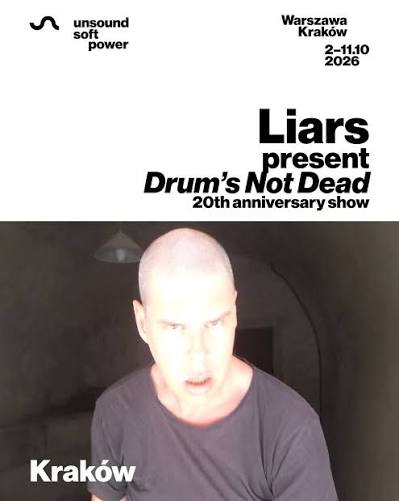
Twenty years after the release of Drum’s Not Dead, Angus Andrew is returning to an album that has never before been performed live in full. At Unsound Festival in Poland, he will revisit it as a different person and artist; convinced that records don’t remain frozen in the moment they were made, but continue to change along with us.
[PRZECZYTAJ TEN WYWIAD PO POLSKU]
At the same time, LIARS are opening a completely new chapter. A Ban On Plastic Bag Bans grew out of several years Andrew spent in Michigan, where he stepped away from music, became involved in a fight against a polluting factory, and learned the limits of individual activism the hard way. We talk about powerlessness in the face of larger systems, the politics of art without writing protest songs, growing older, knowing when to step away from a fight that is no longer yours; and why, after more than two decades, making things still feels as essential to him as breathing.
You’re returning to Drum’s Not Dead twenty years after making it, but at the same time, you’re preparing to release a completely new album. It feels like you’re looking in opposite directions at once. Does it feel that way to you too, or is there something connecting these two records that might not be so obvious to the rest of us?
Well, it does feel like I’m trying to understand two different bodies of work at the same time. But even though Drum’s Not Dead is twenty years old, for me, albums don’t stop existing in the time period in which they were made. Over the twenty years since it was made, the work has taken on more meaning – and different meanings. That record has evolved as much as I have. So when you mention the new album, I also think about the idea of me having evolved to the place where I am now, which is older and maybe wiser – or maybe not. I think it’s interesting to be looking forward and looking back at the same time. I wouldn’t say it’s easy to do both, but I think each of them helps inform the other. When I look back at Drum’s Not Dead, I’d rather focus on how it has evolved. And when I think about the new record, I think about where I’ve come from and how my development as an artist over twenty-five years has led me to this new album.
Have you discovered anything about Drum’s Not Dead that you didn’t fully understand when you made it?
Yeah. First of all, that album has never actually been played live in full before. When we were touring at the time, we used to play maybe half of the songs, but there are some songs I’ve never really known how to play outside the studio. So at the moment, I’m learning all sorts of new things about those songs as the band and I try to figure out how to recreate them.
You’ll be playing with two great Polish drummers. Can you tell me what that process looks like? You’re in Australia, they’re in Poland…
Well, the first step is just to sit down and imagine it. You listen to the song and think about what everybody should be doing, what I should be doing. The first step is really to picture it. Then, yes, we correspond with the musicians, and we’ll meet in Kraków a little earlier to rehearse for a couple of days.
Do you give them some freedom to make the music their own?
Oh yeah, absolutely. It’s really important, especially because they’re drummers and so much of the record comes from that instrument. There’s a lot of space to explore, but at the same time, there’s a lot to learn in terms of structure and how the songs work. That’s what we’ve been working on so far, and I think once we get together in person, it’ll become more exploratory.
In the statement you gave to Unsound, you talked about rhythm as a way of telling stories rather than simply accompanying them. I don’t really have a specific question about that, but I’d love to hear more about the idea.
I think the drum is one of the most primal instruments – or even objects – we have for communication. It goes all the way back to when we lived in caves. There’s something very instinctual about it. The drum is often thought of as just a sort of timekeeper, but on Drum’s Not Dead, we were trying to give it a voice beyond that. A story can be created not only through rhythm, but through the tone of the drum itself. There’s a lot of emotion in it, which isn’t necessarily something people think about when they think of drums. But if you spend some time with it and really focus on it, you start to understand that there are many layers of expression within the drum.
That’s interesting, because when you think about music, drums are such a fundamental and important instrument – and the same goes for bass – but people don’t really think about either of them that much. Guitarists are famous, singers are famous, but unless you’re a music nerd, you probably couldn’t name five great drummers.
Yeah, and it’s strange because, especially with dance music, the beat is so important. I feel like it connects with something very deep and primal within us. Maybe that’s why it’s sometimes overlooked – because it’s thought of as such a basic element. But when you give it the space to speak, the drum really has a lot to say.
On Drum’s Not Dead, we have these two forces: Drum and Mt. Heart Attack. Do you still recognize those forces in yourself today? And has your relationship with either of them changed over the last twenty years?
Oh, that’s a really good question. I would say that, like any emotion, you go through periods of ups and downs. The most basic way of thinking about Drum and Mt. Heart Attack is quite obvious: the Drum character is much more intuitive, spontaneous and confident. Mt. Heart Attack is much more brooding, anxious and concerned. I think we all go through different stages, even within the space of a single day, where we feel more like Drum at one moment and more like Mt. Heart Attack at another. Overall, I still haven’t figured out how to find the balance between the two. And maybe that’s just life.
Is there a third character you would introduce if you were making this album today?
I think so. I made this record in my twenties, and I’d be the first to admit that I was quite self-absorbed at that age. And I think that’s okay when you’re in your twenties. It’s a good time to focus on yourself. But nowadays, there are a lot of things that are more important to me than myself. Especially at this particular moment, when there are so many devastating things happening in the world. So I think it would be important to have another character enter the room – one that was much more aware of what’s happening globally.
As you said, you were in your twenties when you made the record. Is there anything about the person you were back then that you still find easy to relate to? And anything that feels difficult to relate to now?
I was living in Berlin when I made this record. I would sleep all day and work all night. It was very isolating, actually, but in a good way. I was quite obsessed with the work I was making, and I didn’t have much time for other people. I can still relate to that person. But the older I’ve gotten, the more I’ve understood that connecting with other people is a really important part of life. So when I think back to that time, I envy the fact that I didn’t really have many concerns apart from the work I was focused on. But nowadays, I think it’s good that I’m a little more well-rounded.
Let’s move on to A Ban On Plastic Bag Bans. I’d love to start with the story that inspired the album.
I moved to Michigan in the United States just at the end of COVID and settled there, hoping to be near my wife’s family and make records. But soon after we settled there, we discovered that there was a factory causing heavy pollution. I decided to stop making music and become an activist. I thought that if I could rally the community, I might actually be able to make some change and force this huge factory to change its ways. The reality was quite shocking for me. My inability to actually create any change was devastating. I was pretty much unsuccessful in doing anything, and I just found myself distraught about it and kind of lost in that landscape. And that’s where the record came from. I started taking photos of the place where I was living as a way of grappling with the circumstances. It was through those photos that I began composing music again and realized that I had actually been making a record for years without creating a single sound.
You’ve described how surprised you were by the lack of interest from people in the community. What was harder for you to deal with: the resistance from institutions, or the feeling that you couldn’t convince other people that something needed to change?
Probably the second one, because psychologically it was very disturbing for me. There was this smell, and obviously that’s something you can’t point at. It’s there in the air, but then the wind changes and suddenly it’s gone. When you’re interacting with your neighbours and other people in the community, and you bring up this smell but they don’t seem to share the same reaction to it, you start questioning whether you’re actually experiencing what you think you’re experiencing. It felt a bit like vertigo to me, or like living in some kind of parallel world. I could swear that I was smelling air pollution, but in a lot of instances I was led to believe that it wasn’t there. That kind of disconnect was really troubling for me.
It’s really strange, because I don’t know if it’s the same in the US, but over here there’s this narrative that we, as individuals, can change the environment through our own choices – not using plastic straws and things like that. And then you actually have an opportunity to change something yourself, but nobody wants to help you and nobody seems to see the need to.
Yeah, that’s true, but you also have to understand the context. All of this was happening during the Trump administration, when there were horrific things going on all around us. So the question becomes: which fight do you choose to get involved in? I can understand why people who had learned to live with something could simply block it out. Maybe they didn’t really have another choice. So I really don’t blame the community for not supporting my cause. I sympathize with them. Part of what I found interesting was this idea that something can keep happening around you and, simply through repetition, you begin to adapt to it. That became one of the more interesting aspects of the record for me: what happens to you psychologically when you simply learn to accept something. It’s quite sad.
At the same time, A Ban On Plastic Bag Bans refers to an actual law where you live.
Yeah. There’s an actual law in Michigan and several other states that says the state can’t ban a company from giving out plastic bags. In a lot of other places around the world, you’re no longer given plastic bags for your shopping because governments or local authorities have introduced regulations to reduce their use. But in certain parts of America, there’s effectively a law saying that you can’t stop companies from giving them out. For me, that became a symbol of everything that felt so bizarre about living in America at that time. Even the logic of the most obvious things seemed completely backwards and confusing.
That’s why the title felt relevant. I actually wanted to name the record after the factory that was causing the pollution, but the record company told me I couldn’t do that because they were worried about being sued. Even that was interesting to me, because I told them, “Well, now you’re part of this system that censors the language people use to describe their own experience.” But that didn’t really matter. I still couldn’t use the company’s name in the title. And then I realized that, the whole time, I’d had this ridiculous Michigan law in the back of my mind – a ban on plastic bag bans.
You’ve said in the past that you weren’t interested in writing protest songs or telling people what to think or what to do. But this new album seems to have emerged from something very concrete and deeply personal. Has that experience changed the way you think about the relationship between music and politics?
I still don’t think I’m in any position to tell people what to think – or even how to think. I’m not interested in trying to get people to think the way I do. What interests me is the experience we all have when we’re confronted with these incredible powers and find ourselves unable to do very much about them. To me, that’s more interesting than the straightforward idea of a protest song.
What’s interesting about the experience that inspired the record is that it wasn’t just something you went through – your whole family went through it with you. I’m curious about the moment when something like that stops being an issue you read about in the news and becomes part of your own reality. Was there a particular moment when you realized this wasn’t something you could simply ignore or leave for someone else to deal with?
Yeah. From my daughter’s school, you could see this plume of pollution rising into the air right behind where she was playing outside. The first chance I got, I went to what was basically a town hall meeting where state authorities were presenting their findings on air quality. And they literally said, “On days when it’s bad, just stay indoors.” But obviously, children are still going to be outside playing. I think that was the moment when I became the angriest and the most vocal. I knew that, for me at least, I had to put everything else aside and confront this problem. But it also had a lot to do with my own psychology – living in this place and feeling like I needed to come to terms with what was happening. My way of doing that was to get involved in this fight, and it basically took over my life for a couple of years.
But eventually you stepped back from it.
Yeah.
Your wife continued, though. Was it difficult for you to accept that you couldn’t do everything you had hoped to do?
Yeah, but it also became pretty obvious to me that I was this loud, white Australian guy in the middle of America, while the pollution was primarily affecting a predominantly Black neighbourhood. I certainly wasn’t the right spokesperson. I wasn’t the person who should have been the loudest in the room. That’s kind of my nature, but it wasn’t difficult for me to understand that I shouldn’t be the one out front, driving the whole thing. Thankfully, my wife and a group of other concerned parents and members of the community were still willing to do the work. They’ve made some progress. It’s difficult, but they’ve made progress, and I’m proud of them. For me, it was also important to make art. That’s what I do. Maybe part of understanding my place in the whole process was realizing that this was the role I could play.
Do you think there’s a difference between giving up on something and recognizing the limits of what you can personally contribute?
I think that, in life, realizing what you don’t want to do is just as important as knowing what you do want to do. That’s why I think it’s good to try everything. It helps you figure out what you actually don’t want, and that helps you move forward. “Giving up” is quite an extreme way of putting it, but in a sense it can mean understanding that a particular road isn’t the one you should be travelling down. And once you understand that, you’re choosing a different path – one that’s actually important to you. I think that’s an important distinction.
You’ve been making music for more than two decades now – through different line-ups, different cities and completely different periods of your life. What does LIARS give you today that you don’t think you could get from starting something entirely new?
In one way, I feel like I have a debt to repay for all the years I’ve had the opportunity to make music. Only recently have I started reaching out more to other artists – younger artists, people I feel I might have something to offer in terms of helping them with their ambitions. So in that sense, I feel really honoured to have been doing this for so long. But I do sometimes think about what it would be like to drive a school bus every day and have a kind of life where I wasn’t constantly thinking about what I was making. There’s a real beauty and simplicity in doing a job where you can feel that the work has been completed.
Being a builder or something like that – I envy that a lot. Because when you work as an artist, the work is never done. And that can be difficult. When I moved to America and got involved in the fight with the factory, for the first time in twenty years I made a conscious decision not to make anything. I thought it was important to focus on that battle, but I also thought a creative break might be good for me. The idea is that after a break, you come back refreshed. But the only thing it did for me was plunge me into deep depression and despair. Making things is my way of breathing. If I’m not doing that, I struggle. So as much as I’d love to just have some other kind of job – being a gardener sounds beautiful to me – I struggle when I’m not able to make things.
Check our other interviews – here!